A book for devs who don't want to fall behind
AI already writes code. So what makes a good developer now?
Go beyond vibe coding and master the engineering behind AI agents that actually work in production.
Prompt engineering, context engineering, harness engineering, evals and more. All explained in practice, by building a real project from scratch.
The book is written in Brazilian Portuguese.
One-time payment. Instant access to the book and the examples.
Knowing how to ask AI for code is no longer enough.
Today, anyone can open Cursor or Claude Code, write a prompt and generate an app.
But there is a huge difference between getting AI to generate code and knowing how to build reliable software with AI.
- What happens when the model makes something up?
- When an agent gets stuck in a loop?
- When a prompt change breaks something that worked?
- When you need a decision to be made correctly, every time?
The answer is not writing longer prompts.
It is understanding the engineering around the model.
That is what you will learn in this book.
Stop being just an AI user. Learn to build with it.
Instead of teaching isolated concepts, the book follows the build of an AI Interviewer.
An app where an AI interviews a candidate by voice, runs the conversation and scores the performance at the end.
Along the project, you will learn to:
- Specify exactly what the agent needs to do.
- Control the context that reaches the model.
- Set rules the AI cannot ignore.
- Build agents with limits, checks and stopping criteria.
- Test and measure the quality of the answers.
- Protect your app against prompt injection.
- Understand when to use multiple agents.
You won't just learn the terms. You will understand how to apply them in a real system.
What separates a vibe coder from an AI Engineer?
Vibe coder
- Asks the AI to build a feature.
- Trusts that the answer is right.
- Tries to fix errors by changing the prompt.
- Tests by hand and hopes it keeps working.
- Doesn't know exactly why the agent failed.
AI Engineer
- Defines specifications and acceptance criteria.
- Builds mechanisms to validate the model's behavior.
- Uses code to enforce rules and limits.
- Creates evals to catch regressions.
- Can explain, test and improve the system's architecture.
The difference is not who writes more code. It is who knows what needs to be built, how to validate it and why it works.
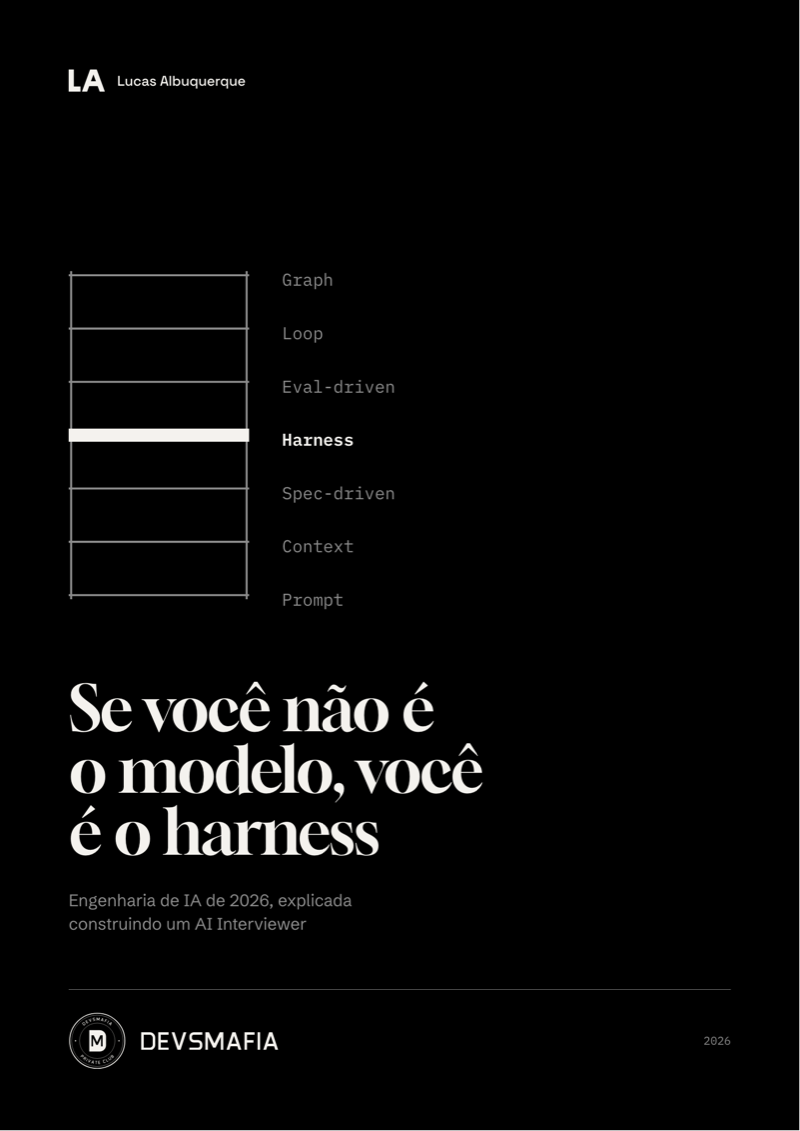
7 disciplines every developer should know in the AI era.
- 01
Prompt Engineering
Learn to guide the model without relying only on written instructions.
- 02
Context Engineering
Control what reaches the model and see why more context doesn't always mean better answers.
- 03
Spec-Driven Development
Turn ideas into specifications and acceptance criteria that coding agents can execute.
- 04
Harness Engineering
Build the structure that controls the agent, enforces rules and makes its behavior verifiable.
- 05
Eval-Driven Development
Learn to measure your system's quality and catch when a change makes results worse.
- 06
Loop Engineering
Understand how agents run tasks, check results, repeat actions and know when to stop.
- 07
Graph Engineering
Get to know the structures used to coordinate different agents and execution flows.
All connected to the same project, with examples you can run and study.
Walk into your next interview able to explain what really matters.
Saying you use ChatGPT, Cursor or Claude Code is not enough.
You need to explain how you build, test and protect systems that depend on language models.
That's why the book includes 15 technical interview questions, with answers, on architecture, agents and AI engineering.
Among them:
- 10
“What is loop engineering and where does it show up in your app?”
- 5
“How do you know you can trust your judge?”
- 6
“The candidate types text that goes into the judge's prompt. What prevents abuse?”
- 3
“Why is the final score computed in code and not by the AI?”
- 12
“How do you guarantee reproducibility?”
Learn to talk about AI engineering with authority, not just repeat terms you saw online.
Everything you get for R$ 97.
The full book as a PDF
13 chapters and an appendix, in Brazilian Portuguese, explaining the core disciplines of modern AI engineering.
Hands-on examples
Files and examples from the project to run, study and adapt.
15 interview questions with answers
A script to review the concepts and practice explaining them in a technical interview.
AI engineering glossary
The main concepts explained directly, to look up whenever you need.
One-time payment
R$ 97
No subscription. No monthly fee.
Instant access after payment.
Questions
Is the book in English?
No. The book is written in Brazilian Portuguese. Only this page is in English.
Do I need to know how to code?
It helps, but you do not need to write code to follow the chapters. Each term is explained the first time it appears, and the glossary collects them all at the end.
What format is it in?
A PDF, plus a zip file with the examples. Both are ready to download right after payment, and the link to the download page arrives by e-mail.
Is it a subscription?
No. You pay R$ 97 once and the book is yours.
I lost the download link. What now?
Look for the purchase e-mail, which has the link. If you cannot find it, write to hi@devsmafia.com with the e-mail you used to pay.
Code is getting cheaper. Knowing how to build is getting more important.
AI is changing the work of building software.
You can keep using these tools just to generate code.
Or you can learn the engineering needed to build AI systems that go beyond a demo.
R$ 97. One-time payment. Instant access.